We visited Zanzibar in August this year. The trip was for 5 days and I travelled with my husband. By our third day I still could not make up my mind whether I liked Zanzibar as a holiday destination. Reason being that at every turn I felt like I was being exploited. Ordinarily you go on holiday because you want some time out, privacy and relaxation.
This holiday was far from that primarily because of how the tourism economy of Zanzibar is run. It appeared to me that they are trying to accommodate both locals and big hoteliers in their tourism economy. It was quite common to be approached by locals selling this or the other while lying at the beach. That I am of melanin colour seemed to encourage this further as they seemed to think a sister would support their cause.
At every turn there was a local willing to sell you a product or offer you an excursion at a cheaper price than the hotel or the touring company. Similarly when you went to the market, you soon learnt that there is no fixed price for anything, you negotiate. Otherwise you will pay the tourist price. I found this frustrating. So as we approached the end of our tour I had had it with the endless bargaining. It began feeling like you had to grease someone’s hand to get through anywhere.
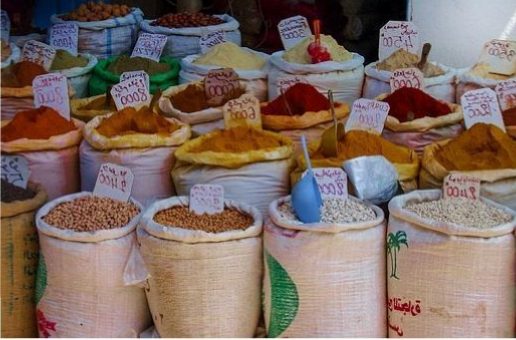
Step in the travel agent who arranged the spice tour for us. I didn’t want to take chances with this one, as it was top on the list of things I wanted to do in Zanzibar. We did the spice tour in the morning of our departure on the way to the airport. The weather favoured us and as it was still early in the morning the air was crisp and fresh, perfect for smelling and tasting herbs and spices.
On arrival we were introduced to the tour guide, a young man with a gentle smile. He explained that we would have to smell or taste the herbs and spices to guess what they are as we moved along the farm. This made the tour exciting and interactive. The young guide was very knowledgeable about the origins of the spices how they are grown, harvested, and their use.
As the tour progresses you soon realise that spices are very much a part of Zanzibar and an essential part of the people’s culture. They use spices as flavourants for distinct Zanzibar cuisine and also to provide cures for every day ailments.
For example they use cinnamon to treat flu and bacterial infections because of the spice’s anti-fungal, anti-bacterial and anti-viral properties. Cardamom is used as a first aid tool to stop hiccups and vomiting. It is also used in making pilau rice, meat and fish dishes and making masala. Clove, known as the king of spices in Zanzibar because of its critical role in the Zanzibar economy, is used by locals to whiten and strengthen their teeth. Preferring cloves over regular toothpaste they also use cloves to neutralize bad breath.
Zanzibar was once the world’s leading producer of cloves, but sales have since fallen with Indonesia now being the largest producer, producing 75% of the world’s cloves, with Zanzibar taking 3rd producer status at 7% of world production.

Young men showing off their lipstick plant coloured lips

Lipstick plant fruit
They also use spices to yield dyes and cosmetic products that are sometimes required to celebrate weddings and festivals. We got to smell cinnamon, jasmine, and vanilla scented Channel Zero perfumes. Channel Zero is a common home-made perfume brand in Zanzibar. The henna tree on the other hand is used by the ladies to decorate their bodies. Apparently there is no lady without this plant which is dried to form a powder which they mix with lemon and water and then make the necessary decorations on their hands face and feet. The Masai also use it to dye their hair. Another common herb used for cosmetics is the lipstick plant which is used for red lipstick and to dye fabrics using the seeds which are pounded to release the colour.
They are also very much about using everything from a plant as evidenced by their use of the cinnamon and lemongrass plant.The leaves of lemon grass are used for green tea, the stalk for cooking, the root for soup and the oil for mosquito repellant.
From the cinnamon tree they use the leaves, the bark and the roots, hence cinnamon spice is known as the queen of spices in Zanzibar.
 Alongside the spices and herbs they grow tropical fruits like jackfruit, papaya, lychees, and pineapple. I had never seen nor tasted jackfruit before so I was very curious about this very large fruit. It has a taste which is somewhere between the taste of lychees and banana.
As the morning progressed more people arrived and I started noticing that there was an entire business model to the spice farms. There were several tour guides, speaking various foreign languages and also fluent in them in order to accommodate their clientele. Each guide had an assistant and made sure not to interrupt another guide and his visitors. In this part of town and during the tour I saw the model of incorporating locals in the tourism economy working perfectly.
Visiting the spice farm brought to life a lot of spices and herbs that I had only seen in dried form and some which I had never seen before. I remember learning at culinary school that black and white peppercorns are produced from the same plant but picked and processed differently.
Standing at the farm and seeing the green peppercorns, it suddenly made sense how they become black. It’s because they are harvested when green and dried, hence the pungent flavor and aroma.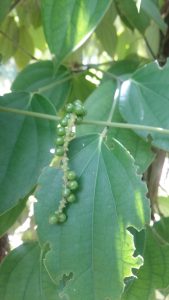 White peppercorns on the other hand are peppercorn berries that are allowed to ripen, this is when they turn red, and then fermented and the outer skin washed off. The definition of spices became real, strongly flavoured or aromatic portions of plants used as flavourings. Spices can be buds (cloves), bark (cinnamon), roots (ginger and turmeric), berries (peppercorn), seeds (cumin) or stigma of a flower (saffron).
After this tour spices are no longer about adding flavor to food. They are not merely a supporting act. Spices are essential in the preservation of food. For example cinnamon fights the fungal, bacterial and viral elements in foods, thus preventing spoilage.
Through this tour, Zanzibar had redeemed itself in my eyes. And as the tour concluded, I made sure to get myself some Vanilla scented Channel Zero perfume, just to make the memory linger for a while longer.
October 25, 2017 at 1:39 pm
Love this. You’re a true foodie as I see you enjoyed the spice tour than anything else in Zanzibar
October 27, 2017 at 7:34 am
This was one of the attractions in me choosing to travel there. there aren’t many places in Africa where you can experience the spices in their true form, before they are packaged
October 27, 2017 at 8:02 am
Hi AvhaathuNtsho,
I saw you tweeting about money and I thought I’d check out your website. I really like it. Looks like AvhaathuNtsho has come a long way!
Have you thought of building a mailing list? I think people would really like to be signed up to what you have to share.
Good job on the social buttons, social media is so powerful these days
You should consider installing an SEO plugin like Yoast or something, theres loads of good free ones.
Also places like axtschmiede.com are worth checking out.
October 27, 2017 at 12:53 pm
Hi John. Thanks for your feedback. Avhaathu just loves dabbling in things that interest her, like money and food. I noted and appreciate your comments regarding SEO plugins, are you in this line of business?
October 28, 2017 at 3:10 am
Really enjoyed reading this. I just felt your passion in every sentence. Thank you as this was very informative as well, learned a lot. Keep up the good work.
October 28, 2017 at 5:35 pm
Thank you Tsumi. I appreciate the feedback.
November 1, 2017 at 1:24 pm
Avhaathu great read. Flows well and quite informative. Keep them coming. I know nothing about spices..this i loved.
November 1, 2017 at 6:47 pm
Wow Cia. Thanks so much. I am glad you found something that you enjoyed on the blog. Hopefully one day I inspire you to actually try out some of the spices.
November 2, 2017 at 7:42 pm
Great blog! This brought back memories of when Kate and I visited Zanzibar, the locals can really frustrate but it is a beautiful island with beautiful beaches. My expectations of the spice tour were so high as I expected a spice factory, lol! so you can imagine my disappointment. So only started becoming interested in spices when I started cooking for the boys, that’s when I realized how the spices enrich food incredibly, adding sweet basil and parsley to the boys mince makes a significant difference to the taste. Really looking forward to more nuggets of wisdom from your page.
November 2, 2017 at 8:14 pm
Oh Sizo, your spice tour expectations!!! I have to keep my voice down cos everyone is sleeping. You have made my day. How do you travel all the way to Zanzibar to visit a spice factory. Too much Robertsons spice in your life:) I can only imagine what was going through your mind as they were showing you a vanilla or ginger plant. Must have been quiet a shock. We have a lot to thank the kids for isn’t it. So you/ the kids also love mince? My sister Huli doesn’t understand the obsession in my family. She thinks I bully everyone into eating it, but it really is everyone favourite. Herbs and spices bring food to life. Yeah, Zanzibar really is a beautiful place. I have not seen beaches like that anywhere and warm too.
May 11, 2018 at 8:56 pm
Hi there! Do you know if they make any plugins to assist with SEO? I’m trying to get my blog to rank for some targeted keywords but I’m not seeing very good results. If you know of any please share. Appreciate it!
May 12, 2018 at 1:34 pm
whoah this blog is excellent i love studying your posts. Keep up the great work! You know, a lot of individuals are hunting round for this information, you can help them greatly.
May 12, 2018 at 6:06 pm
It¡¦s really a great and useful piece of info. I¡¦m satisfied that you just shared this helpful info with us. Please stay us up to date like this. Thanks for sharing.
May 12, 2018 at 9:11 pm
Good day! This is my first visit to your blog! We are a collection of volunteers and starting a new initiative in a community in the same niche. Your blog provided us useful information to work on. You have done a wonderful job!
May 14, 2018 at 4:21 pm
I have recently started a blog, the info you provide on this website has helped me greatly. Thanks for all of your time & work.
May 14, 2018 at 9:12 pm
Great work! This is the type of information that should be shared around the web. Shame on the search engines for not positioning this post higher! Come on over and visit my web site . Thanks =)
May 17, 2018 at 12:09 pm
Please let me know if you’re looking for a writer for your site. You have some really good posts and I feel I would be a good asset. If you ever want to take some of the load off, I’d really like to write some material for your blog in exchange for a link back to mine. Please blast me an email if interested. Many thanks!
August 20, 2018 at 11:12 pm
Hello! This is my 1st comment here so I just wanted to give a quick shout out and say I genuinely enjoy reading your articles. Can you recommend any other blogs/websites/forums that deal with the same subjects? Thanks a lot!
August 22, 2018 at 8:34 am
I was reading through some of your articles on this site and I think this web site is really informative ! Continue posting .
August 22, 2018 at 6:50 pm
Thank you. will do my best!
July 5, 2020 at 2:48 pm
I simply want to tell you that I am beginner to weblog and honestly loved your website. Almost certainly I’m planning to bookmark your website . You really come with fabulous article content. Thanks a bunch for revealing your web site.
July 14, 2020 at 6:00 pm
thank you